

FUND-A-LIBRARY
2026
Help us raise $30,000 online before the gala on November 7.
Online gifts are one part of our $150,000 total goal, which also includes the silent auction, gala ticket sales, and the paddle raise at Taste & Tribute to fund this year's full text distribution.
A 1,400-year-old tradition of wisdom and compassion, saved one book at a time.
What They Carried into Exile
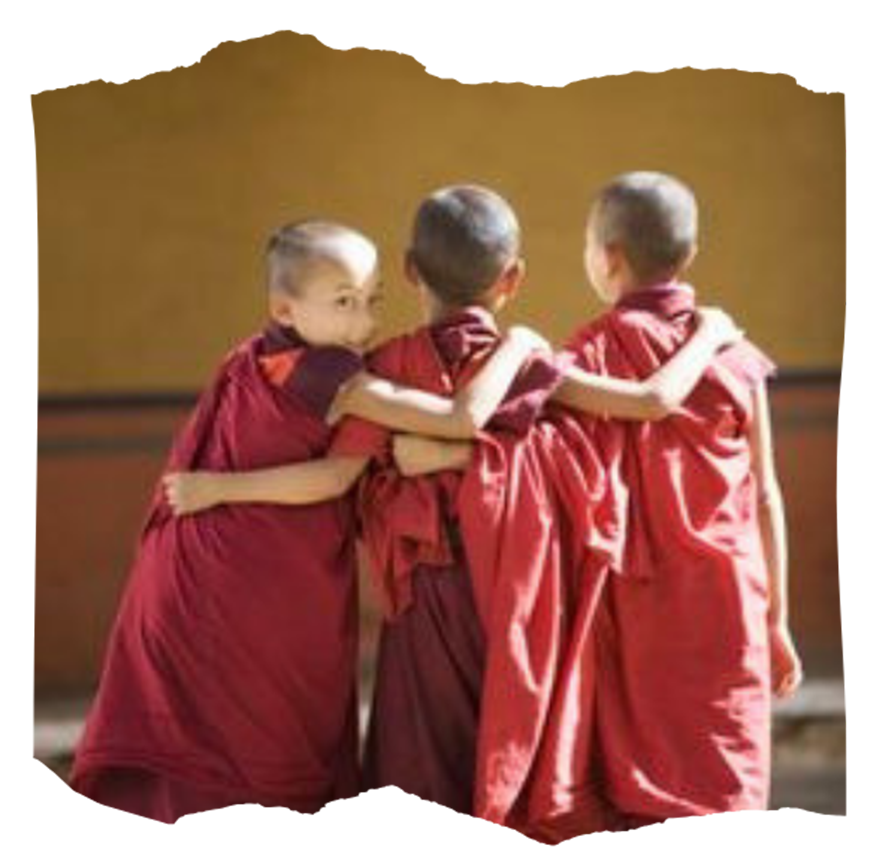
When Tibet's monasteries and libraries were destroyed in the mid-twentieth century, refugees fleeing on foot over the Himalayas faced an impossible choice about what to carry. Many chose books over food — understanding that these texts, preserved and transmitted for 1,400 years, were the lifeblood of Tibetan culture. If the books were lost, the wisdom tradition at the heart of Tibetan identity would be lost with them.
-
Among the world's great intellectual and wisdom traditions, Tibetan civilization is singular in one respect: for more than a millennium, its scholars directed sustained, rigorous attention toward understanding the nature of the mind — producing a body of literature on perception, cognition, emotion, and human flourishing that has no real equivalent elsewhere.
Meditation, mindfulness, and contemplative methods are now finding their way to us, and validated by modern psychology. Tibet's contribution to this inheritance is distinctive in its depth and comprehensiveness: an encyclopedic body of literature on the mind, vast in scope and still being fully understood, that underpins not only scholarly study but the daily practice and ritual of countless practitioners.
In the mid-twentieth century, a period of devastating upheaval destroyed nearly all of Tibet's monasteries and libraries, and sent tens of thousands into exile. What happened next says something profound about what these texts meant to those who carried them: fleeing on foot over the Himalayas, many chose to carry books, sacrificing space that could have gone to food or other essentials.
Acts of preservations like this are why this tradition has survived. The work of ensuring these texts remain in circulation — complete, authoritative, and accessible to the scholars and practitioners who need them — is still urgent today. Many of the scholars who carried this tradition into exile are reaching an advanced age, and the window to pass their knowledge to a new generation is closing.
Modern life has only made these conditions harder — economic pressure, migration, and the pull to chase success over inner knowledge all compete for the time and resources that sustained study once had.
Supporting this tradition is not charity toward a distant culture. It is stewardship of something that belongs, in some sense, to everyone.
Your Gift, in Their Hands
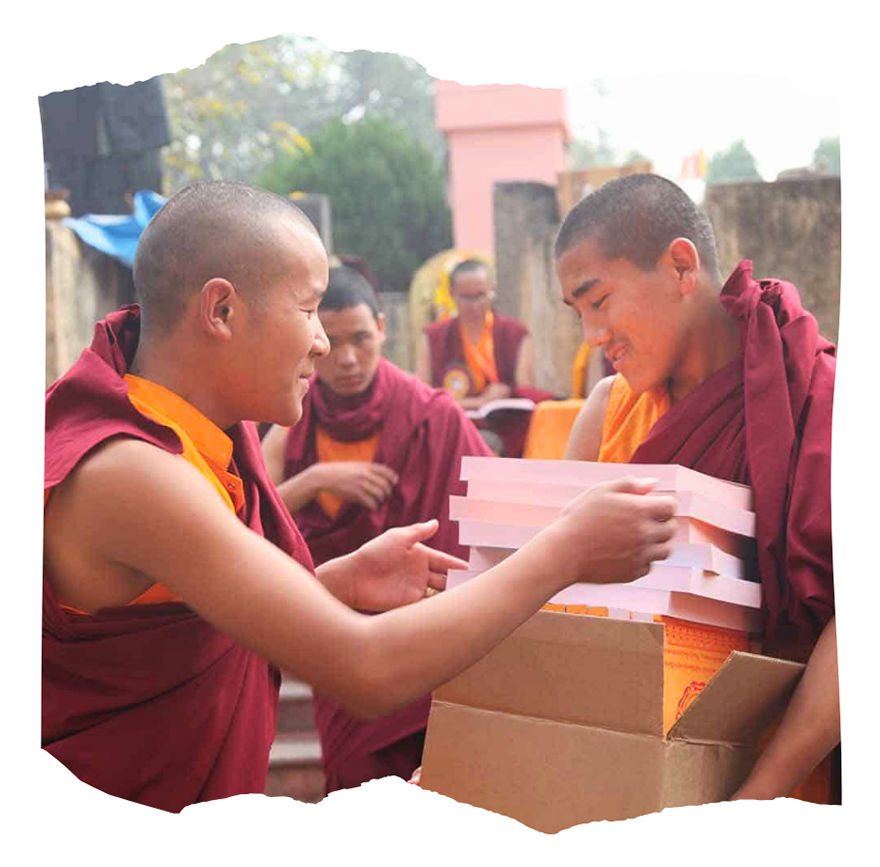
Every gift to this campaign funds the printing and distribution of complete, authoritative text collections, including the Kangyur and Tengyur, the core texts of Buddhist study, at the 2027 World Peace Ceremony in Bodh Gaya, where monks, nuns, meditators, and laypeople from across the Himalayan region gather to receive them.
Every text is, in effect, a physical scholarship—the tools of a serious education, placed directly in the hands of someone who could not otherwise obtain them. For women, whose access to advanced scholarship was historically limited, receiving one's own copy of these works is particularly significant.
"Whichever commentary you wish to read is now at hand — which is unbelievably beneficial." — Orgyen Topgyal Rinpoche
This year's distribution is anchored by two great texts — one of wisdom, one of compassion.
-
The Prajnaparamita — the "Perfection of Wisdom" — is a 28-volume collection representing one of the most expansive bodies of thought in the Tibetan literary canon: a sustained inquiry into the nature of mind and reality itself.
The Mani Kabum is devoted to Avalokiteshvara, the embodiment of compassion, and is the wellspring of Om Mani Padme Hum — the mantra of compassion recited daily by millions. Attributed to King Songtsen Gampo, the 7th-century ruler who brought written language to Tibet, it has carried the practice of compassion through fourteen centuries.
Wisdom and compassion are the tradition's antidotes to ignorance, greed, hatred, and division — the roots of so much human suffering. These texts carry the example of people who embodied those qualities, and the methods by which they cultivated them. When you fund these books, you put that wisdom and compassion into the world — right now, when it's needed most.
Over 4,600 texts will delivered at the 2027 World Peace Ceremony in Bodh Gaya. This year’s texts include:
Prajnaparamita Collection
A 28-volume collection representing one of the most expansive bodies of thought in the Tibetan literary canon.
1,000 copiesTarpa chenpo mdo — Sutra of Great Liberation
Part of the Kangyur — the vast canonical collection at the heart of Tibetan literary heritage.
2,400 copiesSuvarna Prayer Book — The Golden Light Sutra
Carried by rulers across Asia for over a thousand years as a cornerstone of cultural identity.
750 copiesMani bKa'-'bum
A rare text attributed to King Songtsen Gampo, the 7th-century ruler who brought written language to Tibet.
120 copiesShes bya mdzod — Treasury of Knowledge
The magnum opus of Jamgon Kontrul (1813–1899), an encyclopedic work covering the full breadth of Tibetan intellectual life.
120 copiesBiography of Padmasambhava (Nyangral, Ratna Lingpa & Sogdogpa)
A collection of three biographies of the 8th-century figure central to Tibetan cultural history.
130 copiesBiography of Padmasambhava (Orgyen Lingpa)
A biography attributed to the treasure-revealer Orgyen Lingpa — together with the above, a layered portrait of one of Tibet's most formative figures.
140 copies
No One Is Turned Away
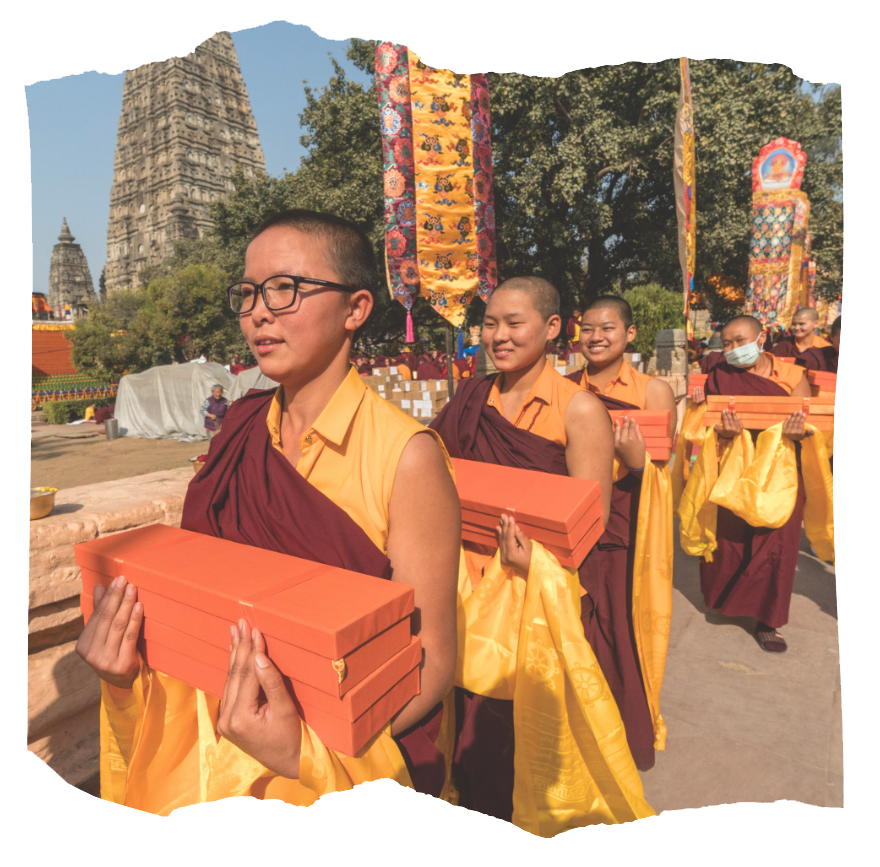
Over 5 million books have been given to all four schools of Tibetan Buddhism — reaching 3,300 centers of learning across India, Nepal, and Bhutan. In January 2026 alone, TAP distributed 28,206 texts.
In the Dolpo region of Nepal, villages send a hundred people at a time on the journey to Bodh Gaya to bring the books home.
"When they finally receive the books, they are amazingly happy... No one is turned away, whether a monk or the most humble lay person." — a practitioner from the Dolpo region
What began in 1969 as a grassroots effort to support Tibetan refugees has grown into one of the largest text distribution projects in the world.
-
In 1983, the organization's mission expanded from refugee support to cultural preservation specifically — the beginning of TAP's work distributing Tibetan-language texts.
Each year, representatives of monasteries and institutions from across the Himalayan region — along with individual monks, nuns, meditators, and laypeople — gather in Bodh Gaya, India for the World Peace Ceremony. It is there that TAP distributes complete, authoritative text collections that are otherwise difficult to obtain, including the Kangyur and Tengyur, the core texts of Buddhist study and philosophy.
'In the past, the Tengyur and Kangyur was very rare in the Himalayan regions. In Tibet, very few monasteries had a Tengyur and Kangyur,' says a Geshe of Drepung Gomang Monastery, India. 'Tengyur and Kangyur is the main source of study about Buddhism and Buddhist philosophy.'
Make Your Gift
Give before November 7, and the books you fund ship this winter — arriving in Bodh Gaya in time for January's World Peace Ceremony.
$10,000 provides 1,000 books
$5,000 provides 500 books
$2,500 provides 250 books
$1,000 provides 100 books
$500 provides 50 books
$250 provides 25 books
$100 provides 10 books
*Based on average cost per book across this year's distribution.
Campaign closes the night of Taste & Tribute. All gifts are tax-deductible.
Questions about this campaign? Contact Pauline at tap@tibetanaidproject.org
Joining Us in Person?
Taste & Tribute takes place on Friday, November 7 at the Nyingma Institute in Berkeley — an evening of four courses, wine pairings, and a silent auction in support of this work. Tickets are $400 per person, which includes a $300 tax-deductible contribution.