
Mandala
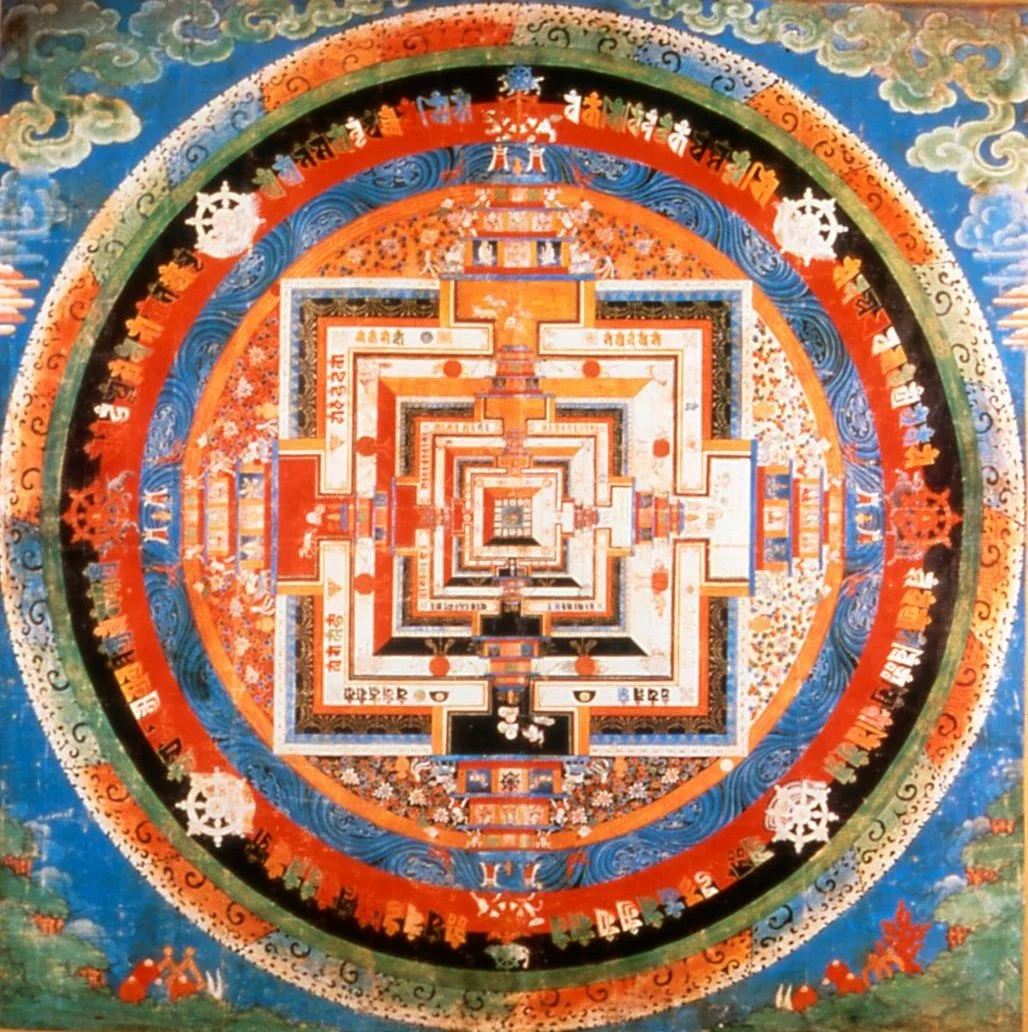
The mandala portrays the five traditional elements – earth, air, fire, water, and space – which combine to form our beautifully unified world, the setting for all life. From these elements arise our five senses, which can unite together with conscious mind to manifest realization. The mandala is a pictorial representation of the undefiled mind, which demonstrates that perfect realization encompasses all things.
Traditional Mandala
A traditional mandala depicts a beautiful temple as seen from an aerial view. On the outer border is a ring of fire, a symbol of the transformative qualities of knowledge that can illuminate our existence and dissolve the obscurations that bar us from entering the mandala. The next layer often includes a ring of vajras, symbols of the diamond-like indestructibility of the teachings, with their emphasis on skillful means and enlightened action. A ring of lotus blossoms follows the ring of vajras. The lotus grows out of muddy water to emerge pure and unstained. It is a traditional image that symbolizes the promise of transformation for all beings, for the purity of our buddha-nature blooms out of the mud of samsara.
After passing through these three rings, we reach the multi-hued walls of the temple itself. Each wall has an arch or pagoda in the center, representing the doorway that leads to the heart of the mandala, where a deity is seated on a jeweled throne supported by a lotus. Different mandalas portray different deities, each of which can be thought of as an aspect of consciousness that can be transformed into enlightened awareness.
Colors in a Mandala
White:
Placement: On the bottom
Direction: East
Element: Water
Emotion: Anger that can transform into reflecting all appearance in perfect symmetry.
Yellow:
Placement: On the left
Direction: South
Element: Earth
Emotion: Pride and ego that can transform into recognizing the humanity we all share.
Red:
Placement: On the top
Direction: West
Element: Fire
Emotion: Desire, lust, and greed that can transform into compassion
Green:
Placement: On the right
Direction: North
Element: Wind
Emotion: Jealousy that can be transformed into all-accomplishing action
Blue:
Placement: In the center
Element: Space
Emotion: Ignorance that can transform into wisdom and intelligence
How the Mandala Inspires Us
The beauty and order of the mandala can inspire us to allow the positive qualities we already intrinsically embody to manifest. Anywhere in the natural world, we can see the five elements interacting harmoniously with grace. In the interplay of thoughts and emotions within our own mind, we can recognize the possibility for each negative manifestation to be transmuted into pure expressions of healing and holistic balance.
The mandala can show us how to skillfully access our own awareness. Just as the colors red, blue, green, white, and yellow can be combined to create a painting of vivid beauty and inspiration, so the thoughts, emotions, and feelings that color our experience can be integrated as a harmonious whole. Awareness and compassion teach us that the cares and concerns of others are like our own. Seeing this, we are well on the way to creating an attitude that sustains harmony within and without, attuning us to the elemental world in which we live.